
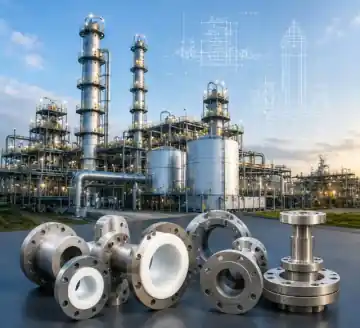
Chemical Industry PTFE — Material Specifications, Engineering Data & OEM & ODM Supply
Produced at our Gujarat manufacturing works, Chemical Industry PTFE offers superior sealing and wear resistance for chemical industry components. Combines virgin and reinforced PTFE fluoropolymer grades with precision compression moulding and 100% batch quality inspection for OEM applications.
Where Chemical Industry PTFE is used
PTFE is chosen for near-universal chemical inertness, a −200°C to +260°C service band, and the lowest friction of the common engineering polymers.
Common in acid dosing, solvent transfer and reactor service across chemical and petrochemical plant.
Key properties
Gaskets and envelope seals for corrosive flanges
Valve seats, balls, and stem seals for chemical service
Filled PTFE for wear-critical pump components
Drawing-based spacers and machined parts
Material certificates and export documentation
Specifications
| Property | Value |
|---|---|
| Component Type & Grade | Chemical Industry PTFE (Specification Code HES-874) |
| Base Raw Material | PTFE fluoropolymer (Virgin FDA 21 CFR 177.1550 / Custom Filled) |
| Continuous Service Temp. | -200°C to +260°C (-328°F to +500°F) |
| Tensile Strength at Break | 20 to 35 MPa (Virgin) / 14 to 25 MPa (Filled) |
| Elongation at Break | 250% to 450% (ASTM D4894) |
| Specific Gravity / Density | 2.14 to 2.18 g/cm³ (ASTM D792) |
| Dielectric Strength | 50 to 80 kV/mm (0.1 mm film) |
| Surface Roughness Finish | Diamond Polished Ra ≤ 0.20 µm to Ra ≤ 0.40 µm |
| Dimensional Tolerance | ISO Grade 1 to Grade 3 / Drawing Nominals (±0.02 mm) |
| Manufacturing & Origin | Moulded, Sintered & CNC Machined in Dahegam, Gandhinagar, Gujarat, India |
Manufacturing process
The manufacturing process for Chemical Industry PTFE utilizes precision cold preforming of PTFE fluoropolymer followed by oven sintering. Automated hydraulic press cycles ensure consistent green compact density, which prevents localized voids and ensures uniform thermal expansion behavior during finish machining passes.
Material selection notes
Engineered from high-purity PTFE fluoropolymer, this component resists virtually all industrial acids, alkalis, and aggressive organic solvents. The non-stick, self-lubricating surface minimizes drag and prevents material buildup in fluid handling systems. Compressive deformation under load is optimized through tailored filler grades based on service pressure.
How to specify your order
To configure Chemical Industry PTFE for your application, submit component dimensions, operating PV factors, and delivery port requirements. Our engineering team prepares complete technical evaluations and formal quotations within 24 hours.
Quality checks and inspection
Testing procedures for Chemical Industry PTFE include optical comparator profile inspection, hydrostatic pressure holding tests on seal components, and material hardness checks (Shore D) to verify full sintering cure.
Ordering and export documentation
Domestic Chemical Industry PTFE orders ship with GST invoice and e-way bill where applicable. Export orders include commercial invoice, packing list, and certificate of origin from our IEC-registered works. Recurring supply schedules supported with fixed drawing revision and lot numbering for plant stores Contact info@hemsun.com or sales@hemsun.com with your PTFE components specification. In addition to precision PTFE components, HEMSUN manufactures dedicated PTFE compression moulding presses (20T–300T) and hydraulic powder compaction machinery in-house to support chemical equipment manufacturers with complete vertical production capabilities. In addition to precision PTFE components, HEMSUN manufactures dedicated PTFE compression moulding presses (20T–300T) and hydraulic powder compaction machinery in-house to support chemical equipment manufacturers with complete vertical production capabilities.
Export packing and lead time
Export logistics for Chemical Industry PTFE cover global delivery via air freight or ocean container through Mundra and Nhava Sheva ports. Products are packed with protective foam wrapping and moisture-barrier film inside export-grade wooden crates, accompanied by certified commercial invoices and Certificates of Origin.
Storage and handling
Handling and assembly guidelines for Chemical Industry PTFE: Components should be kept in protective polybags until final assembly. Use clean, rounded assembly mandrels when installing over shaft threads to prevent surface scratches or edge nicking.
Compliance & Standards
Material certificates and inspection reports available for project documentation. Export shipments include commercial invoice, packing list, and certificate of origin from our IEC-registered facility.
Frequently Asked Questions
Why is PTFE preferred in chemical processing plants?
PTFE resists a wide range of acids, solvents, and caustics while maintaining sealing integrity across temperature cycles. It is specified for gaskets, valve trim, linings, and machined spacers in aggressive media service.
Which HEMSUN products suit chemical industry duty?
PTFE gaskets, filled PTFE bushings, valve seats, diaphragms, and drawing-based machined parts are commonly supplied for pumps, reactors, and transfer lines.
Related Machinery, Tooling & Technical Guides
Manufacturing Presses
Engineering Process Guides
Related Products
Related Articles

Can PTFE Balls Be Used in Drinking Water Systems?
View DetailsChoosing the Right Ball Size for a Check Valve
View Details