
Quick Answer
PTFE valve balls are solid fluoropolymer spheres used in ball check valves, relief valves, and soft-seat assemblies — not the large shutoff ball in a floating ball valve. They provide chemical-proof, low-friction sealing from -200°C to +260°C in corrosive and sanitary fluid lines.
What Are PTFE Valve Balls?
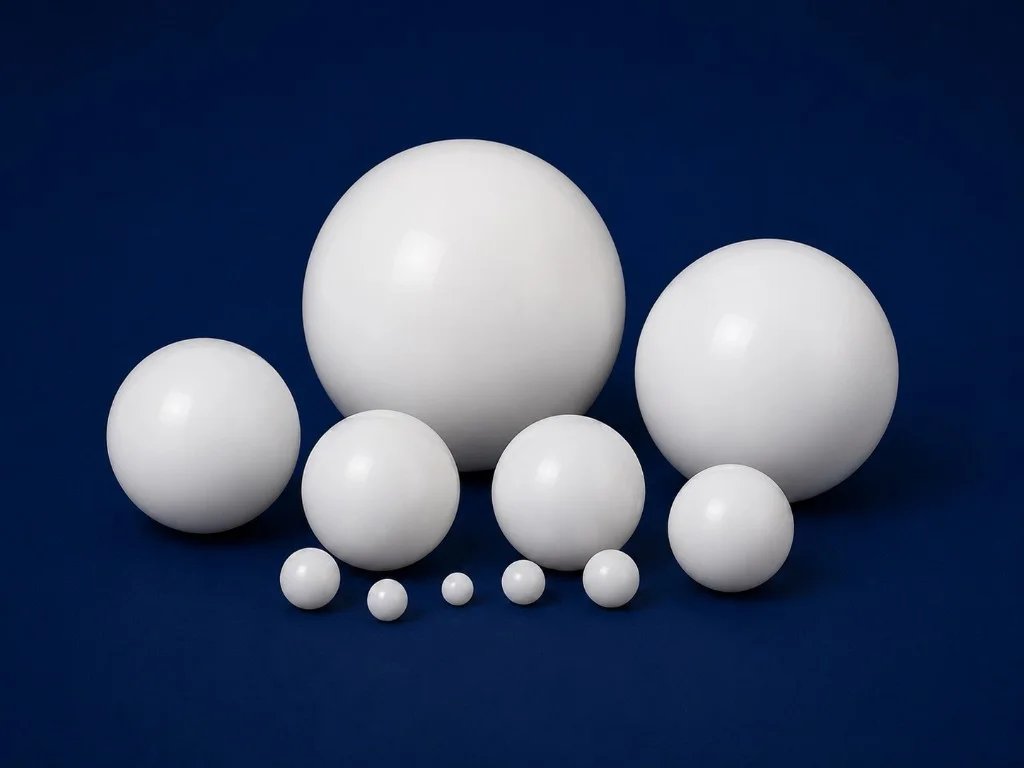
In valve engineering, a PTFE valve ball is a solid sphere that acts as the moving closure element in a ball check valve or as a soft sealing component against a valve seat. When forward flow pressure lifts the ball off the seat, fluid passes. When flow stops or reverses, the ball returns to the seat and blocks backflow.
This is different from a floating ball valve, where a large ball (often metal with PTFE lining) is the main shutoff element rotated by a stem. Our PTFE valve balls are precision-ground solid spheres — typically 6 mm to 76 mm — supplied to valve OEMs and repair programs. See virgin PTFE balls for product specifications.
Why PTFE for Valve Applications?
-
Chemical inertness: Unaffected by sulfuric acid, hydrochloric acid, chlorine, solvents, and caustic solutions.
-
Low cracking pressure: Density ~2.15 g/cm³ — lighter than metal balls, lifts easily off the seat.
-
Seat conformity: Slight cold flow under load helps the ball conform to minor seat imperfections at low pressure.
-
Non-stick surface: Balls do not seize in the seat after long idle periods — critical for intermittent-duty check valves.
-
Temperature range: -200°C (cryogenic LNG) to +260°C (steam and hot chemical lines).
Common Valve Types Using PTFE Balls
| Valve Type | PTFE Ball Role | Typical Diameter | Recommended Grade |
|---|---|---|---|
| Ball check valve | Moving closure sphere | 6 mm – 50.8 mm | Virgin PTFE (/virgin-ptfe-ball) |
| Relief / safety valve | Seat sealing element | 12.7 mm – 25.4 mm | Virgin or glass-filled PTFE |
| Multi-port manifold valve | Line identification sphere | 6 mm – 19 mm | Coloured PTFE (/coloured-ptfe-ball) |
| Vacuum breaker | Gravity-return check ball | 9.52 mm – 19.05 mm | Virgin PTFE |
| High-pressure chemical valve | Wear-resistant check sphere | 12.7 mm – 38.1 mm | Glass/carbon-filled PTFE (/custom-ptfe-ball) |
Size Selection for Valve Seats
Ball diameter must match seat bore geometry and target cracking pressure. Undersized balls leak; oversized balls raise cracking pressure or jam. Standard metric and inch sizes are listed on our PTFE ball size chart. For non-standard seat geometries, submit valve drawing via RFQ.
PTFE Valve Ball vs Metal Valve Ball
| Property | PTFE Valve Ball | Metal (SS/Brass) Ball |
|---|---|---|
| Chemical resistance | Universal (except molten alkali metals) | Limited — corrodes in acids |
| Cracking pressure | Lower (lighter density) | Higher (heavier) |
| Max temperature | +260°C continuous | Depends on alloy |
| Contamination risk | Zero leaching (virgin grade) | Metal ion contamination possible |
Related Guides
-
PTFE Pump Balls (/ptfe-pump-balls) — check spheres in reciprocating pumps
-
Selection Guide (/ptfe-ball-selection-guide) — grade and tolerance framework
-
Applications Overview (/ptfe-ball-applications) — all industrial uses
-
Teflon-Equivalent PTFE Balls (/teflon-ball) — product page for Teflon-branded searches
Technical specifications and application guidelines
HEMSUN ENGG. INDUSTRIES manufactures and engineers high-precision solutions for ptfe valve balls at our Dahegam, Gujarat facility. Every component and machine is built to international standards with complete dimensional traceability.
Comparative Engineering Data Matrix
| Specification / Property | Virgin PTFE / Standard Range | Filled / High-Performance Variant | Testing Standard |
|---|---|---|---|
| Specific Gravity / Density | 2.14 to 2.18 g/cm³ | 2.20 to 3.80 g/cm³ (by filler type) | ASTM D792 |
| Tensile Strength at Break | 20 to 35 MPa (2,900–5,000 psi) | 15 to 25 MPa | ASTM D4894 |
| Elongation at Break | 250% to 450% | 100% to 300% | ASTM D4894 |
| Operating Temperature Range | -200°C to +260°C (-328°F to +500°F) | -200°C to +280°C | Continuous Service |
| Dielectric Strength | 50 to 80 kV/mm (0.1 mm film) | 15 to 40 kV/mm | ASTM D149 |
| Coefficient of Friction | 0.05 to 0.10 (Dynamic against steel) | 0.08 to 0.15 | ASTM D1894 |
Procurement & Quality Assurance Checklist
- Material Traceability: 100% virgin suspension resin or certified filler masterbatch with raw material test reports (MTR).
- Dimensional Verification: CMM coordinate inspection, digital micrometer checks, and optical surface roughness profilometry (Ra ≤ 0.4 µm).
- Packaging & Shipping: Domestic delivery via express road freight with GST tax invoices; global exports in seaworthy crating with IEC certificate of origin and commercial invoices.